Showing posts with label France. Show all posts

Sunday, September 7, 2014

Borodino: The victory that was not

Μνημείο για τον Πατριωτικό Πόλεμο της Ρωσίας ενάντια στους Γάλλους εισβολείς
Plain memorial of the Patriotic War in the outskirts of Moscow

The French Invasion of Russia, known in Russia as the Patriotic War of 1812 (Russian: Отечественная война 1812 года) began on 24 June 1812 when Napoleon's Grande Armée crossed the Neman River in an attempt to engage and defeat the Russian army

On 7 September 1812 the French caught up with the Russian army which had dug itself in on hillsides before a small town called Borodino, seventy miles west of Moscow. The battle that followed was the largest and bloodiest single-day action of the Napoleonic Wars, involving more than 250,000 soldiers and resulting in 70,000 casualties. The French gained a victory, but at the cost of 49 general officers and thousands of men. The Russian army was able to extricate itself and withdrew the following day, leaving the French without the decisive victory Napoleon sought.

Tuesday, June 10, 2014

Oradour and Distomo

German troops in front of buildings set ablaze in Distomo, during the massacre

A double crime anniversary: 70 years from the June 10, 1944, massacres of Oradour-sur-Glane in France and Distomo in Greece, by German Waffen-SS units. 

German courts, citing the 1961 bilateral agreement concerning enforcement and recognition of judgments between Germany and Greece, and Section 328 of the German Code of Civil Procedure, rejected the decision of the Greek High Court in favor of reparation claims of Distomo victims' relatives, because "Greece does not have jurisdiction with regard to the actions in question, which were sovereign acts by a state (i.e. the German state)". Thus, for the sake of saving money, German courts transferred the massacre responsibility from the SS-units to the German state ...! Impressive ... 

In more detail: 
In October 1997, the Court of First Instance in Livadia ruled in favor of over 250 relatives of the Distomo massacre victims, ordering the German state to pay approximately €28 million in damages for the 1944 atrocity. 
The Greek Supreme Civil and Criminal Court (Areios Pagos) upheld this ruling on 4 May 2000, affirming that Germany could be held liable. The Court rejected Germany’s claim of state immunity, reasoning that such grave violations of peremptory norms (jus cogens) could not be classified as sovereign acts; thus, immunity did not apply.
Despite the victorious ruling, enforcement within Greece was blocked by law: Article 923 of the Greek Code of Civil Procedure requires prior consent from the Minister of Justice to serve a judgment against a foreign state — permission which was never granted. 
Germany challenged the decision in German and European courts, which were unfavorable:
- All German courts rejected the claims, citing state immunity and a 1961 bilateral treaty
- The European Court of Human Rights also declined to hear the case in 2011, ruling it inadmissible .

The church where the women and children of Oradour were burnt to death

Sunday, July 22, 2012

The massacre at Béziers on Ste. Madeleine's Day

Beziers
 
22 July 1209 (Ste. Madeleine's Day)

The day before, the crusader army, commanded by the Papal Legate, the Abbot of Citeaux Arnaud Amalric, reached the outskirts of Béziers and started to besiege the city, calling on the Catholics within to come out, and demanding that the Cathars surrender. Both groups refused. The army, consisting of knights mostly from northern France, was set up following Pope's Innocent III declaration of a crusade to eliminate Catharism in the Languedoc. 

During the storming of the city on Ste. Madeleine's Day, thousands of Béziers' citizens sought sanctuary in the Cathedral of St Nazaire, which was set on fire, and also in the Eglise de la Madeleine, inside which all were butchered to death. 


"Caedite eos. Novit enim Dominus qui sunt eius - Kill them all, God will recognize his own" was the famous quotation of Arnaud Amarlic, which exonerated the rampaging Crusaders. 


No one was spared, irrespective of rank, sex or age... Contemporary sources give estimates of the number of dead ranging between 15,000 and 20,000.

Sunday, September 19, 2010

September

Jardin de Tuileries, Paris / © I.A. Daglis

It was September. In the last days when things are getting sad for no reason.

Ray Bradbury [The Lake, 1944]

Wednesday, July 14, 2010

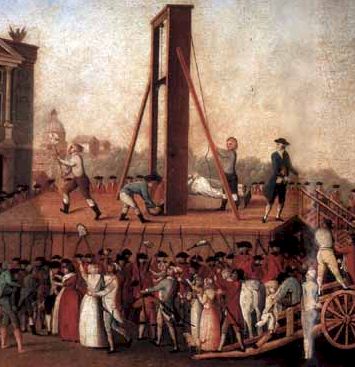
Liberté, Egalité, Fraternité - and their sister Guillotine


Place de la Concorde / I.A. Daglis           


During the French Revolution the new revolutionary government erected the guillotine in the Place de la Concorde (called Place de la Révolution), and the first notable to be executed was king Louis XVI, on January 21, 1793. Other important figures guillotined on the site, often in front of cheering crowds, were Georges Danton, Antoine Lavoisier, Maximilien Robespierre, and Louis de Saint-Just. The guillotine was most active during the "Reign of Terror", when an estimated 18,000 to 40,000 people were executed. In the summer of 1794, in a single month more than 1,300 people were executed. Liberté, Egalité, Fraternité.

Monday, June 14, 2010

Paris, 14 June 1940

Paris - Arc de Triomphe and Palais des Tuileries / © I.A. Daglis     

German troops marched into Paris in the early hours of this morning as French and allied forces retreated.
The enemy met no resistance as it entered the capital, which was declared an open town yesterday by the city's French military governor, General Hering.
French troops withdrew to avoid a violent battle and total destruction of Paris. They are believed to have taken a new line of defence south of the city.
The Germans advanced from the north-east and north-west and shortly afterwards tanks rumbled past the Arc de Triomphe down the Champs Elysees to the Place de la Concorde.
BBC, 14 June 1940

Saturday, February 20, 2010

alone again

Aix-en-Provence, June 2008 / © I.A.Daglis

Yeah, said it's all right
I won't forget
All the times I've waited patiently for you
And you'll do just what you choose to do

And I will be alone again tonight my dear.

Bryan MacLean and Love [Alone again or, 1967]

Love - Alone again or

Wednesday, November 25, 2009

Petit bonheur

"Au petit bonheur", Aix-en-Provence 2008 / © I.A. Daglis

That man is richest whose pleasures are the cheapest.

Henry David Thoreau (American writer and philosopher, 1817-1862)

Thursday, November 5, 2009

Φθινοπωρινά φύλλα

La Seine / Ile de la Cite, Paris Oct2009 / © I.A. Daglis

Σιωπή, ακούμε το φύσημα του αέρα, τα φθινοπωρινά φύλλα θροΐζουν και παρασέρνονται από τον άνεμο, ο γάτος κοιμάται λουσμένος σ’ ένα ζεστό φως.


Muriel Barbery [Η κομψότητα του σκαντζόχοιρου, 2006]